
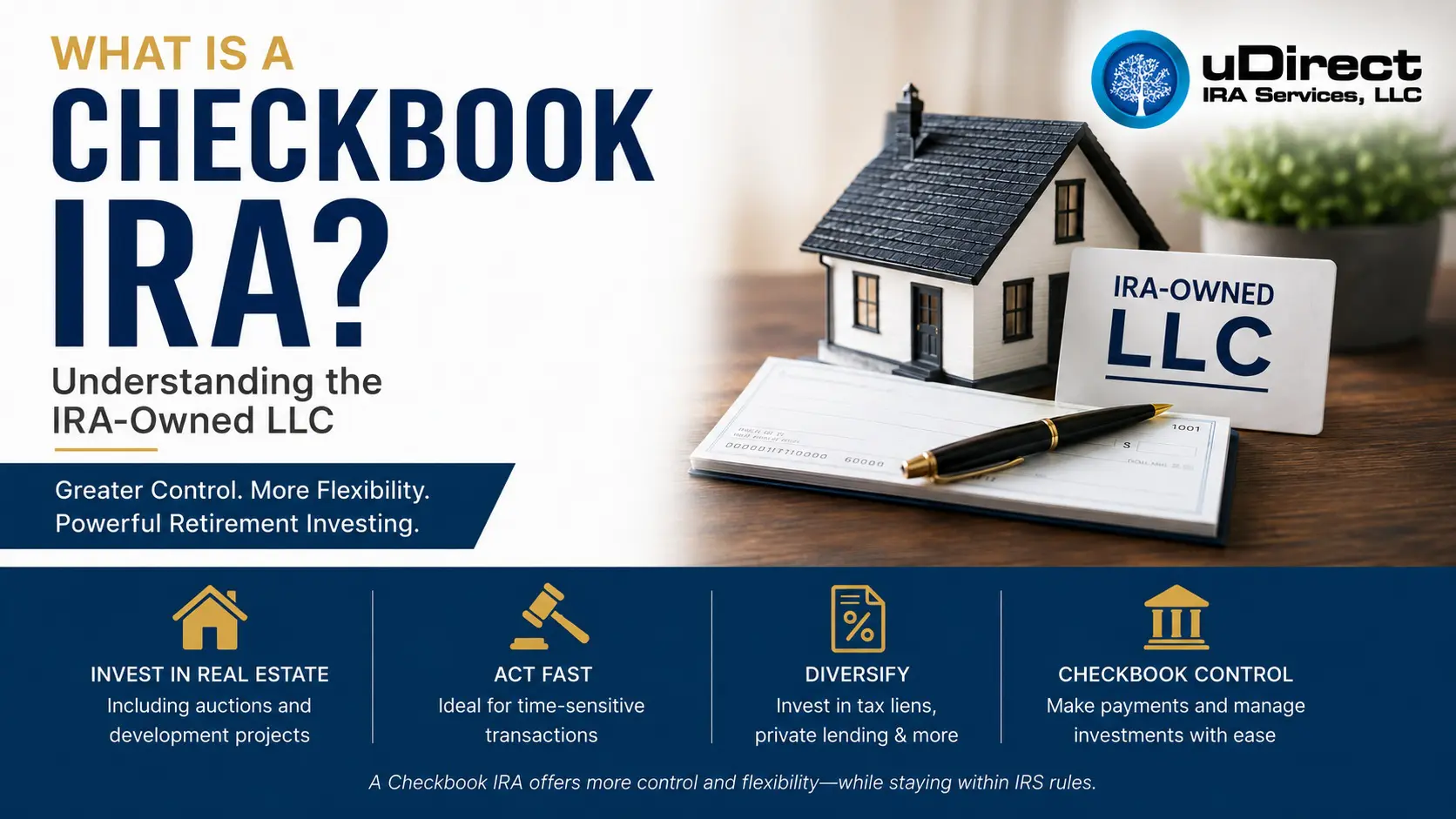
What Is a Checkbook IRA? Understanding the IRA-Owned LLC
A Checkbook IRA, also commonly called an IRA-Owned LLC, is a self-directed retirement strategy that gives investors direct control over how their IRA funds are used for certain alternative assets.
With a standard self-directed IRA, the IRA administrator or custodian processes investment requests, payments, and related paperwork. IRA companies typically process these requests in a timely manner, and this traditional process works well for many investors.
However, some investors need the ability to move quickly in certain situations. That is where the Checkbook IRA structure may be useful.
Instead of asking the IRA administrator to process every investment-related payment, the IRA invests into a specially structured LLC. The IRA owns the LLC, and the investor may serve as the manager of that LLC. This structure can allow the investor to write checks or send funds directly from the LLC’s bank account for approved IRA investments.
For experienced investors, this can create speed, flexibility, and convenience. However, it also comes with important responsibilities.
How a Checkbook IRA Works
A Checkbook IRA starts with a self-directed IRA. The IRA is opened with a custodian or administrator that allows alternative assets.
Next, a limited liability company is created. This LLC is structured so that the IRA is the owner of the LLC. Once the LLC is properly formed and the documents are completed, the IRA funds the LLC by purchasing membership interest in the company.
From there, the LLC opens a bank account. Because the IRA owns the LLC, the funds in that LLC bank account are still retirement funds. They must be used only for IRA-approved investment purposes.
This is why the structure is often called “checkbook control.” The investor, acting as manager of the LLC, may be able to act quickly when an investment opportunity arises.
Why Investors Use a Checkbook IRA
Many self-directed IRA investors use an IRA-Owned LLC because they want greater control over timing and transaction flow.
A Checkbook IRA can be especially helpful when an investment requires fast action, repeated payments, or direct access to funds. This may include buying properties at auction, participating in real estate development transactions, or purchasing tax liens.
For example, real estate investors may need to pay expenses quickly. A rental property owned through an IRA-Owned LLC may have repair bills, property taxes, insurance premiums, utilities, or HOA dues. With a Checkbook IRA, those expenses may be paid directly from the LLC bank account.
Again, many IRA administrators process investment requests efficiently. The Checkbook IRA is not necessarily about replacing that service. Rather, it may be useful when the nature of the investment calls for faster control, more frequent transactions, or immediate payment capability.
Common Investments Held Through an IRA-Owned LLC
A Checkbook IRA may be used for many of the same alternative assets allowed inside a self-directed IRA, including:
Real estate
Properties purchased at auction
Real estate development transactions
Private lending
Tax liens
Private placements
Other alternative assets allowed under IRA rules
The key is that the investment must be held for the benefit of the IRA, not for the personal benefit of the IRA owner or any disqualified person.
The Rules Still Apply
A Checkbook IRA does not remove the IRS rules that apply to retirement accounts. In fact, it usually requires the investor to be even more careful.
The IRA owner must avoid prohibited transactions. This means the IRA-Owned LLC cannot buy from, sell to, lend to, borrow from, or provide personal benefit to the IRA owner or other disqualified persons.
Disqualified persons generally include the IRA owner, the IRA owner’s spouse, parents, grandparents, children, grandchildren, and certain related entities.
For example, you generally cannot use your IRA-Owned LLC to buy a vacation home for personal use. You also cannot personally pay expenses for an IRA-owned property or deposit IRA income into your personal account.
All income and expenses must flow through the IRA-Owned LLC or the IRA itself.
Proper Titling Matters
When investing through a Checkbook IRA, the investment should be titled in the name of the LLC, not in the investor’s personal name.
This is important because the LLC is owned by the IRA. The investor is managing the LLC, but the investor does not personally own the funds or assets.
Correct titling helps preserve the retirement account structure and keeps the investment clearly separated from personal assets.
Recordkeeping Is Essential
A Checkbook IRA gives investors more control, but it also gives them more responsibility.
Investors should keep detailed records of all transactions, including investment documents, bank statements, invoices and receipts, income received, expenses paid, LLC operating documents, and fair market valuation records.
Good recordkeeping helps support the IRA’s tax-advantaged status and makes annual reporting easier.
A Checkbook IRA Is Not Right for Everyone
While a Checkbook IRA can be powerful, it is not the right fit for every investor.
Some investors prefer the traditional self-directed IRA process, where the IRA administrator processes investment paperwork and payments. This can be a strong option for investors who want administrative support and do not need direct checkbook control.
Others may prefer the added flexibility of an IRA-Owned LLC, especially when buying assets at auction, handling development-related expenses, managing tax lien investments, or dealing with transactions that require speed.
Before choosing a Checkbook IRA structure, investors should understand the rules, costs, responsibilities, and potential risks.
It is also wise to consult with qualified legal, tax, and investment professionals before moving forward.
Education Comes First
At uDirect IRA Services, we believe education is the foundation of successful self-directed retirement investing.
A Checkbook IRA can provide flexibility and speed, but it must be handled correctly. Investors need to understand how the IRA-Owned LLC works, what transactions are allowed, and which actions could create a prohibited transaction.
When used properly, a Checkbook IRA may help investors take greater control of their retirement funds and pursue alternative assets beyond the stock market.
Ready to Learn More?
If you want to learn more about self-directed IRAs, IRA-Owned LLCs, or how retirement funds can be used to invest in alternative assets, contact uDirect IRA Services.
Email: info@udirectira.com
Phone: (866) 447-6598
Website: uDirectIRA.com