
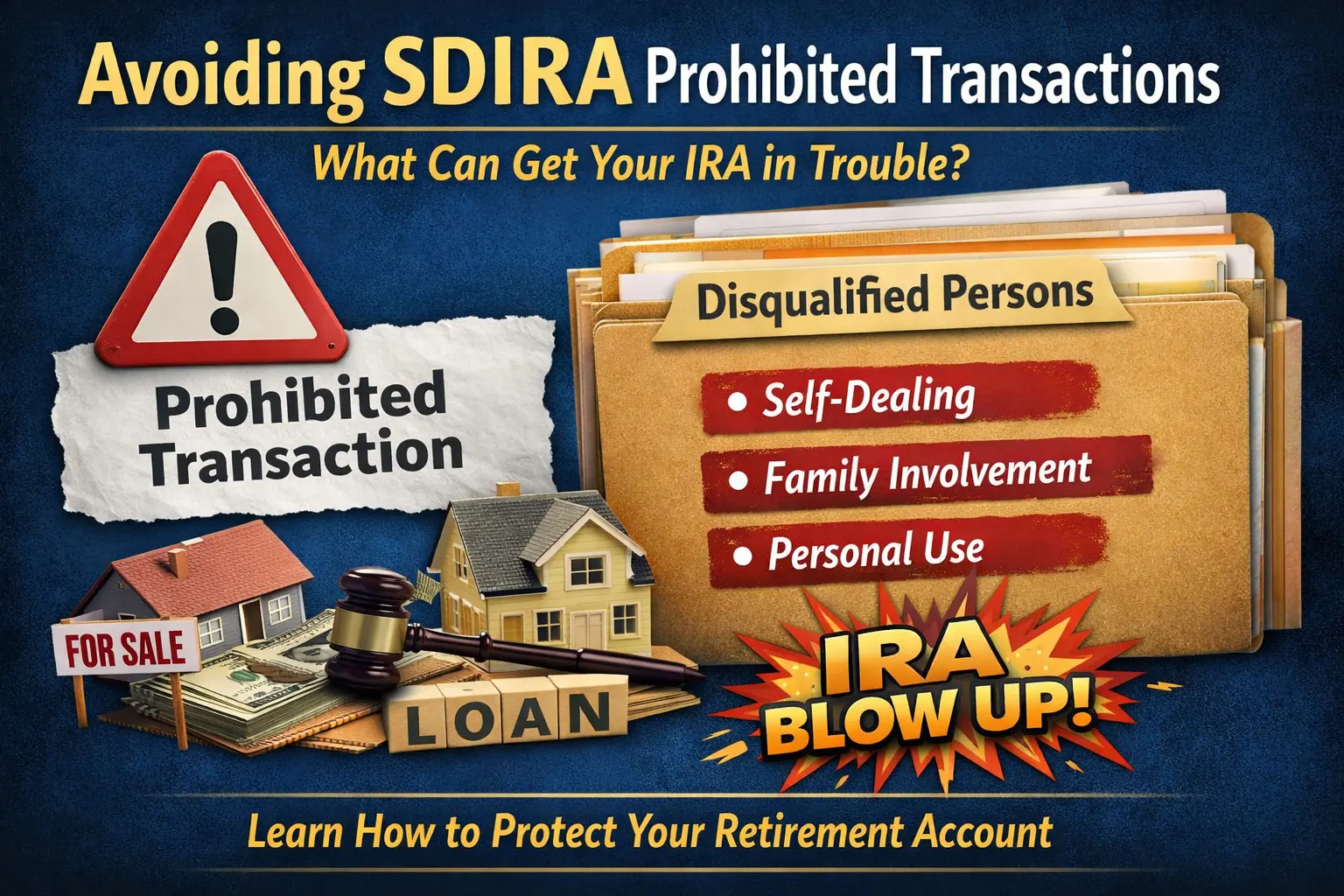
Prohibited Transactions in a Self-Directed IRA: Disqualified Persons, Common Traps, and How to Protect Your Retirement Account
Self-directed IRAs (SDIRAs) can unlock a wider menu of investments—real estate, private lending, private equity, and more. But with that flexibility comes a set of rules that can trip up even experienced investors.
The biggest recurring question is:
“What counts as a prohibited transaction (and who is a disqualified person)—and how do I avoid accidentally blowing up my IRA?”
It comes up so much because the consequences can be severe. The IRS explains that if an IRA owner engages in a prohibited transaction, the IRA can lose its tax-advantaged status as of January 1 of that year, which may trigger taxes (and potentially penalties) on the full value of the account. Let’s break this down in plain English.
What Is a “Prohibited Transaction”?
A prohibited transaction is generally a deal between your IRA (or IRA-owned entity) and a “disqualified person” that involves:
- Self-dealing
- Conflicts of interest
- Personal benefit from IRA assets (directly or indirectly)
- Certain sales, exchanges, loans, or services between the IRA and disqualified persons
The core principle:
Your IRA must be operated for retirement purposes, not to provide current-day benefits to you (or people/entities closely tied to you).
Who Is a “Disqualified Person”?
“Disqualified person” is an IRS-defined category (commonly discussed under IRC 4975 rules) that generally includes:
You (the IRA owner) and your spouse
That’s the big one—and it matters even if you’re “just helping” a deal.
Certain family members (lineal family)
Typically includes:
- Parents and grandparents
- Children and grandchildren
- Spouses of those descendants
Common surprise: siblings are not typically in the lineal family category, but family rules can still get complicated depending on the transaction structure—so always confirm with qualified counsel before assuming.
Entities you control (or that disqualified persons control)
This often includes:
- A company where you (or other disqualified persons) own or control a significant portion
- Certain partnerships, LLCs, trusts, or corporations where control thresholds are met
Fiduciaries and service providers to the plan
This can include parties providing services or exercising authority over plan assets in a way that creates conflicts.
Bottom line: If a person or entity is “too close” to you, your IRA usually can’t transact with them.
The Most Common Prohibited Transaction Traps (Real-Life SDIRA Examples)
Here are practical examples that show how investors accidentally cross the line:
1) Your IRA buys a property you (or your family) use
- Your SDIRA buys a vacation home and you stay there “just one weekend.”
Even a small personal benefit can create a prohibited transaction issue.
2) You personally guarantee a loan to help your IRA deal
- Your IRA-owned LLC needs financing; the lender wants your personal guarantee.
A personal guarantee can be treated as providing a benefit/extension of credit involving a disqualified person.
3) “Sweat equity” or providing services to your IRA’s investment
- You renovate the IRA-owned rental yourself to “save money.”
- You manage the project directly and perform substantial services.
Doing work can be viewed as providing services to your IRA—potentially prohibited.
4) Your IRA lends money to you or your business (directly or indirectly)
- “It’s my retirement money, I’ll pay it back.”
An IRA loan to the owner is a classic prohibited transaction.
5) Your IRA buys from or sells to a disqualified person
- Your IRA purchases a property from your parent or child.
- Your IRA sells a note to a company you control.
Sales/exchanges with disqualified persons are a major danger zone.
6) Mixing personal and IRA money in the same deal
- You and your IRA co-invest improperly or pay expenses personally and “reimburse later.”
Even good intentions can create prohibited “contributions” or self-dealing concerns.
Why the Consequences Are So Serious
The IRS’s prohibited transaction framework is designed to prevent retirement accounts from being used like personal checking accounts.
Per the IRS guidance, if an IRA owner engages in a prohibited transaction, the IRA can be treated as distributed as of January 1 of that year, potentially creating:
- Immediate taxable income on the account value
- Possible early distribution penalties (depending on age and circumstances)
- A major disruption to long-term compounding
That’s why this topic deserves real attention before you fund a deal.
How to Avoid Prohibited Transactions (Without Losing the Benefits of SDIRA Investing)
Here are practical, investor-friendly strategies that reduce risk of prohibited transactions:
1) Keep a “Disqualified Person” list handy
Before you invest, ask:
- Is this person my spouse, parent, grandparent, child, grandchild, or their spouse?
- Is this entity controlled by me or any of those people?
- Will I (or they) receive any personal benefit from the investment?
2) Treat your IRA like it belongs to a separate stranger
That mindset helps. If you wouldn’t do the transaction with a stranger’s retirement account, don’t do it with yours.
3) Never pay IRA investment expenses personally
All investment-related expenses should be paid from the IRA (or IRA-owned entity) and all income should return to the IRA—properly documented.
4) Avoid personal services (“sweat equity”) on IRA assets
Use third-party professionals for property management, repairs, and improvements.
5) Be cautious with IRA-owned LLCs and checkbook control
Checkbook control can speed up investing, but it can also make it easier to accidentally:
- Pay the wrong expense
- Sign the wrong contract
- Cross wires with personal funds
If you use an IRA LLC, strong processes and professional guidance are essential.
6) Get guidance before signing, not after
A quick review with a qualified tax professional or ERISA attorney before committing can save enormous pain later.
A Simple Pre-Investment Checklist (Bookmark This)
Before your SDIRA invests, confirm:
✅ No part of the deal involves a disqualified person
✅ No personal use or current-day benefit will occur
✅ No personal guarantee, lending, or self-dealing is involved
✅ All income flows back to the IRA
✅ All expenses are paid from the IRA (not reimbursed)
✅ Contracts are titled correctly (IRA/IRA LLC as buyer/lender)
✅ You’re not providing services to the investment
✅ You have documentation and a clean paper trail
Final Thoughts
Self-directed IRAs are powerful, but the rules are not forgiving. The best SDIRA investors build a repeatable process: screen the parties, structure correctly, document everything, and keep personal benefit completely out of it.
If you’re exploring SDIRA real estate or private lending strategies, the safest approach is to slow down at the front end, ask the right questions, and get clarity before money moves.
Want Help Pressure-Testing Your Deal Structure?
If you’d like, share the broad outline of what you’re trying to do (asset type, who the parties are, and how funds will flow), and I can help you identify common prohibited transaction red flags to discuss with your tax/ERISA professional.
Disclaimer: This post is for educational purposes only and does not provide tax or legal advice. For guidance on your specific situation, consult a qualified tax advisor and/or ERISA attorney.
Contact Us:
Whether you want to invest in real estate, crypto, or private companies, we can help you get started with a self-directed IRA. We’re here to help you stay compliant while you grow your retirement wealth confidently and intelligently.
Call us today at (866) 447-6589
Email us at info@uDirectIRA.com
Book a Call: HERE
Let’s make your retirement investing work for you—not just Wall Street.