
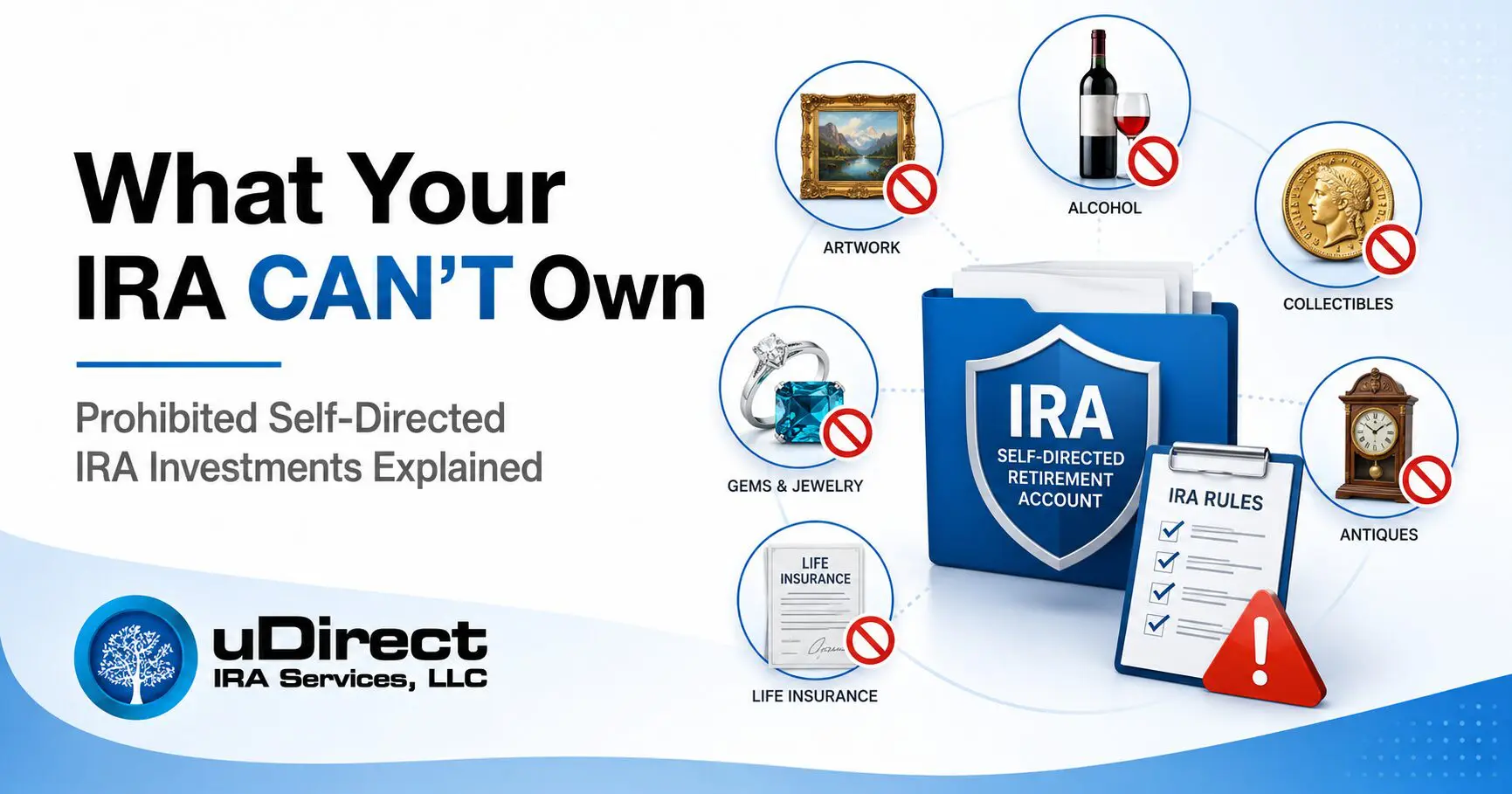
What Your IRA CAN’T Own: Prohibited Self-Directed IRA Investments Explained
A Self-Directed IRA can invest in many alternative assets, including real estate, private equity, private lending, promissory notes, certain precious metals, and privately held companies.
However, a Self-Directed IRA cannot own everything.
Federal tax rules generally prohibit an IRA from investing in life insurance contracts and most collectibles. In addition, an otherwise allowable investment can create an IRA prohibited transaction when it involves personal use, self-dealing, improper compensation, or a transaction with a disqualified person.
Quick Answer: What Can’t a Self-Directed IRA Own?
A Self-Directed IRA generally cannot own:
- Life insurance contracts
- Artwork
- Rugs and antiques
- Gems
- Stamps
- Most collectible coins
- Alcoholic beverages
- Most collectible metals
- Certain other tangible personal property classified as collectibles
Certain qualifying gold, silver, platinum, and palladium coins or bullion may be permitted when the applicable requirements are satisfied. (IRS)
The short list of prohibited assets may appear simple. However, Self-Directed IRA investors must also understand prohibited transactions, disqualified persons, self-dealing, personal use, and proper IRA asset ownership.
What Is a Self-Directed IRA?
A Self-Directed IRA, often called an SDIRA, is an individual retirement account that allows the account owner to direct investments into a broader range of assets than those commonly offered by banks and brokerage firms.
A Self-Directed IRA is not a separate type of IRA under the Internal Revenue Code. Traditional IRAs, Roth IRAs, SEP IRAs, and SIMPLE IRAs can potentially be self-directed when the custodian or administrator permits alternative investments.
Common Self-Directed IRA investment options may include:
- Residential and commercial real estate
- Private equity
- Private placements
- Limited liability companies
- Promissory notes
- Private lending
- Tax liens
- Certain precious metals
- Cryptocurrency
- Undeveloped land
- Mortgage notes
- Real estate syndications
The IRS does not provide a comprehensive list of every investment an IRA may own. Instead, federal law identifies certain prohibited investments and restricts transactions involving the IRA owner and other disqualified persons.
What Investments Are Prohibited in a Self-Directed IRA?
The primary investments an IRA cannot own are life insurance and most collectibles.
-
Life Insurance Contracts
An IRA cannot purchase or own a life insurance contract.
This restriction applies whether the policy insures:
- The IRA owner
- A spouse
- A family member
- A business partner
- An unrelated person
The restriction is based on the nature of the asset itself. It is not simply an investment limitation imposed by a particular Self-Directed IRA custodian.
-
Artwork
Artwork is generally classified as a collectible and cannot be purchased as an IRA investment.
Examples may include:
- Paintings
- Sculptures
- Drawings
- Photography
- Limited-edition artwork
- Decorative art
- Other collectible creative works
An IRA cannot purchase a painting and display it in the account owner’s home or office. The purchase of the artwork itself may be treated as a distribution, regardless of where it is displayed.
-
Rugs and Antiques
An IRA generally cannot invest in collectible rugs or antiques.
Examples may include:
- Antique furniture
- Historic decorative objects
- Vintage rugs
- Rare household items
- Collectible clocks
- Antique jewelry
- Museum-quality furnishings
The possibility that an item may increase in value does not make it an eligible Self-Directed IRA investment.
-
Gems
Gems are generally treated as collectibles.
A Self-Directed IRA generally cannot directly purchase:
- Diamonds
- Rubies
- Emeralds
- Sapphires
- Loose gemstones
- Collectible jewelry
An IRA investment in a business that operates within the gemstone industry may present a different analysis from directly purchasing and holding gemstones. The legal structure, ownership interest, transaction parties, and underlying assets should be reviewed by qualified legal or tax counsel.
-
Stamps
Collectible stamps and stamp collections are generally prohibited IRA assets.
This may include:
- Rare stamps
- Historic postage
- Commemorative stamp collections
- First-day covers
- Other philatelic collectibles
-
Alcoholic Beverages
An IRA generally cannot invest directly in alcoholic beverages.
Examples include:
- Fine wine
- Whiskey
- Bourbon
- Scotch
- Champagne
- Rare spirits
- Collectible wine collections
A Self-Directed IRA may potentially invest in an unrelated operating company involved in producing or distributing beverages. However, that is different from having the IRA directly purchase and hold bottles as collectible assets.
-
Most Collectible Coins
Not every gold or silver coin is eligible for an IRA.
Most collectible, rare, commemorative, or numismatic coins are classified as collectibles. The value of these coins may depend heavily on rarity, condition, age, or collector demand rather than solely on their metal content.
Certain coins are specifically excluded from the statutory definition of a collectible, but the exact coin must meet the applicable requirements. (IRS)
Before purchasing coins through a Self-Directed IRA, confirm:
- The exact type of coin
- The issuing authority
- Whether the coin qualifies under federal law
- Whether the custodian accepts the asset
- How the coin will be titled
- Where the coin will be stored
-
Nonqualifying Precious Metals
A Self-Directed IRA can potentially invest in certain precious metals, but not every precious-metal product qualifies.
Permitted precious metals may include qualifying:
- Gold
- Silver
- Platinum
- Palladium
Bullion must meet applicable fineness requirements. Qualifying bullion must also be held in the physical possession of a bank or approved nonbank trustee. (IRS)
Products that may create problems include:
- Collectible coins
- Rare coins
- Jewelry
- Decorative metals
- Metals that fail to meet fineness standards
- Personally held IRA metals
- Metals stored under the personal control of the IRA owner
Can a Self-Directed IRA Own Gold?
Yes, a Self-Directed IRA may own certain qualifying gold coins and bullion.
However, the gold must meet applicable legal requirements, and the custodian must be willing to administer the investment.
Several factors matter:
- The form of the gold
- Its fineness
- Whether it is a qualifying coin or bullion product
- The identity of the seller
- The ownership and titling
- The storage arrangement
- Whether the IRA owner has possession or personal control
The fact that an item contains gold does not automatically make it IRA eligible.
Can You Store Self-Directed IRA Gold at Home?
Personally storing IRA-owned gold at home can create substantial tax and compliance risk.
Federal law provides an exception for certain bullion when it is held in the physical possession of a bank or an approved nonbank trustee. Investors should not assume that placing IRA metals in a personal safe, home storage facility, or individually controlled safe-deposit box satisfies this requirement. (IRS)
Before purchasing precious metals through an IRA, consult a qualified legal or tax professional regarding the proposed ownership and storage arrangement.
What Happens If an IRA Buys a Collectible?
When an individually directed retirement account acquires a collectible, the amount paid for the collectible is generally treated as an immediate distribution to the account owner.
For example, suppose an IRA pays $25,000 for a prohibited work of art. The $25,000 purchase amount may be treated as a distribution to the IRA owner.
Potential consequences may include:
- Taxable income
- A possible additional tax for an early distribution
- Reporting obligations
- Interest or penalties
- Loss of future tax-advantaged growth on the distributed amount
The IRS identifies limited exceptions for certain qualifying coins and precious-metal bullion. (IRS)
Prohibited Assets and Prohibited Transactions Are Different
A prohibited asset is something the IRA itself generally cannot own.
A prohibited transaction involves an improper transaction between an IRA and the IRA owner or another disqualified person.
This distinction is important.
Real estate is generally not a prohibited IRA asset. Nevertheless, IRA-owned real estate may become involved in a prohibited transaction when the IRA owner:
- Lives in the property
- Vacations at the property
- Allows a disqualified person to use it
- Buys the property from a disqualified person
- Sells the property to a disqualified person
- Personally pays the property’s expenses
- Personally receives its rental income
- Uses the property as security for a personal obligation
- Performs impermissible services for the investment
The asset may be permitted, while the transaction or conduct is prohibited.
What Is an IRA Prohibited Transaction?
An IRA prohibited transaction is an improper transaction between a retirement account and a disqualified person.
Examples may include:
- Selling property to your IRA
- Buying an IRA-owned asset personally
- Lending money to your IRA
- Borrowing money from your IRA
- Using IRA assets for personal benefit
- Pledging IRA assets as security for a personal loan
- Paying personal expenses with IRA funds
- Paying IRA expenses with personal funds
- Receiving improper compensation from the IRA
- Allowing a disqualified person to use an IRA-owned asset
The IRS describes prohibited transactions as transactions between a retirement plan and a disqualified person that are prohibited by law. (IRS)
What Is Self-Dealing in a Self-Directed IRA?
Self-dealing occurs when the IRA owner uses retirement assets to create a current personal benefit rather than holding them exclusively for the retirement account.
Examples may include:
- Purchasing a vacation property with an IRA and staying there
- Using IRA-owned equipment for a personal business
- Directing an IRA to buy an asset the account owner already owns
- Receiving personal compensation from an IRA-owned investment
- Using IRA funds to improve personally owned property
- Using IRA assets to satisfy a personal debt
A Self-Directed IRA must operate for the exclusive benefit of the retirement account. The investor directs the account, but the IRA’s money and property remain separate from the investor’s personal assets.
Who Is a Disqualified Person?
A disqualified person is an individual or entity with whom the IRA generally cannot conduct certain transactions.
Disqualified persons commonly include:
- The IRA owner
- The IRA owner’s spouse
- Parents
- Grandparents
- Children
- Grandchildren
- Spouses of children or grandchildren
- Certain fiduciaries
- Certain service providers
- Certain entities owned or controlled by disqualified persons
The prohibited family line generally runs vertically through the IRA owner’s ancestors and descendants.
Siblings, aunts, uncles, cousins, nieces, and nephews are not automatically included solely because of their family relationship. However, they could be disqualified for another reason, such as serving as a fiduciary or controlling an entity involved in the transaction.
Indirect transactions can also violate the rules. Investors should not assume that placing an LLC, partnership, trust, or another person between the IRA and a disqualified person makes an otherwise prohibited arrangement permissible.
Can a Self-Directed IRA Own Real Estate?
Yes. A Self-Directed IRA can potentially invest in real estate when the custodian accepts the asset and the transaction complies with applicable rules.
Possible Self-Directed IRA real estate investments include:
- Single-family rentals
- Multifamily property
- Commercial real estate
- Undeveloped land
- Mortgage notes
- Tax liens
- Real estate investment entities
- Private real estate funds
- Syndications
- Certain real estate partnerships
However, neither the IRA owner nor another disqualified person can personally use or improperly benefit from the property.
Can a Self-Directed IRA Buy a Vacation Home?
An IRA may potentially purchase residential property as an investment, but the IRA owner cannot treat it as a personal vacation home.
The account owner generally cannot:
- Stay in the property
- Allow a spouse to use it
- Allow parents or grandparents to use it
- Allow children or grandchildren to use it
- Reserve it for future personal use
- Pay expenses personally
- Keep rental income personally
The property must remain an investment of the IRA.
Can You Live in a House Owned by Your Self-Directed IRA?
No. Living in a property owned by your Self-Directed IRA would generally provide an impermissible personal benefit.
This restriction applies even when:
- You pay market rent
- You use the property for only one night
- The property is temporarily vacant
- You plan to distribute the property later
- You believe the IRA is receiving fair value
Paying fair market value does not automatically cure a prohibited transaction involving a disqualified person.
Can You Repair Property Owned by Your Self-Directed IRA?
Self-Directed IRA owners should be cautious about personally performing work on IRA-owned property.
Activities such as selecting investments, reviewing reports, and making investment decisions differ from physically providing labor or services to an IRA-owned asset.
Potentially problematic activities may include:
- Construction
- Plumbing
- Electrical work
- Painting
- Roofing
- Remodeling
- Property management
- Landscaping
- Routine maintenance
A prudent approach is to have the IRA hire and pay qualified third-party professionals. Investors should consult knowledgeable tax or legal counsel before personally providing any service to an IRA investment.
Can a Self-Directed IRA Invest in a Private Company?
Yes, a Self-Directed IRA may potentially invest in a private company, private placement, limited liability company, partnership, or private equity opportunity.
Before investing, evaluate:
- Whether a disqualified person owns or controls the company
- Whether the IRA owner works for the company
- Whether the investor will receive compensation
- Whether the IRA is buying an existing ownership interest from a disqualified person
- Whether the investment may generate unrelated business taxable income
- Whether the entity’s documents permit IRA investment
- Whether the custodian accepts the asset
- Whether the investment can be independently valued
Custodian acceptance does not constitute investment approval or confirmation that the transaction is legally permissible.
Can a Self-Directed IRA Own an LLC?
Yes, an IRA may potentially own an interest in an LLC.
Some investors use an IRA-owned LLC structure, sometimes referred to as an IRA LLC or checkbook-control IRA. However, forming an LLC does not eliminate the prohibited-transaction rules.
The IRA owner must still avoid:
- Personal use of LLC property
- Commingling funds
- Personal payment of LLC expenses
- Improper compensation
- Transactions with disqualified persons
- Personal guarantees
- Personal loans
- Personally benefiting from LLC assets
An LLC is a legal structure, not an exemption from Self-Directed IRA rules.
Can a Self-Directed IRA Invest in Cryptocurrency?
A Self-Directed IRA may potentially invest in cryptocurrency when the custodian supports the investment and the account is structured correctly.
The cryptocurrency must remain an asset of the IRA. Important considerations include:
- Proper account ownership
- Custody of the digital assets
- Wallet control
- Exchange-account registration
- Security procedures
- Valuation
- Transaction documentation
- Avoiding personal use or transfer
Cryptocurrency held personally cannot simply be relabeled as an IRA asset.
Can an IRA Own an NFT?
The tax treatment of a nonfungible token may depend on the asset or right represented by the NFT. Typically an NFT is considered a “collectible” and is disallowed.
For example, an NFT representing ownership of artwork may be treated as a collectible because the underlying asset is a work of art. Investors should obtain qualified tax and legal guidance before using an IRA to purchase an NFT.
Can a Self-Directed IRA Lend Money?
Yes, a Self-Directed IRA can potentially make private loans or invest in promissory notes.
However, the borrower cannot be the IRA owner or another disqualified person.
The loan should be:
- Properly documented
- Made in the IRA’s name
- Funded directly by the IRA
- Repaid directly to the IRA
- Supported by commercially reasonable terms
- Accepted by the custodian
- Structured without a personal benefit to the account owner
The IRA owner should not personally receive the interest or principal payments.
What Happens After an IRA Prohibited Transaction?
The consequences of an IRA prohibited transaction can be severe.
When an IRA owner or beneficiary engages in a prohibited transaction involving the account, the IRA generally stops being treated as an IRA as of the first day of that tax year. The account may be treated as distributing all its assets at fair market value. (IRS)
Potential consequences may include:
- Loss of the IRA’s tax-advantaged status
- A deemed distribution of the account
- Ordinary income tax
- An additional early-distribution tax
- Interest and penalties
- Amended tax returns
- Excise taxes for other disqualified persons
- Loss of future tax-deferred or tax-free growth
Because the potential consequences can affect the entire account, investors should evaluate proposed transactions before committing IRA funds.
Does the IRS Approve Self-Directed IRA Investments?
No. The IRS does not preapprove individual Self-Directed IRA investments.
A custodian’s willingness to hold an asset also does not mean:
- The investment is safe
- The investment is profitable
- The promoter is legitimate
- The offering complies with securities law
- The price is reasonable
- The investment is appropriate for the account owner
- The transaction complies with all tax rules
Self-Directed IRA custodians and administrators generally perform administrative functions. They do not evaluate the quality or economic merits of an investment.
Investors are responsible for conducting due diligence and obtaining qualified tax, legal, and investment guidance.
Custodian Restrictions Versus IRS Restrictions
A Self-Directed IRA custodian may impose investment restrictions that are narrower than federal law.
The IRS allows IRA trustees and custodians to impose additional limitations on the investments they will administer. (IRS)
An investment may therefore fall into one of three categories:
Prohibited by Federal Law
The IRA generally cannot own the asset.
Examples include life insurance contracts and most collectibles.
Potentially Permitted but Structurally Risky
The asset may be allowed, but the parties, use, funding, or transaction structure could create a prohibited transaction.
Real estate is a common example.
Permitted by Law but Rejected by the Custodian
The investment may not be prohibited by federal law, but a particular custodian may decline to administer it.
Possible reasons include:
- Valuation challenges
- Lack of liquidity
- Complex documentation
- Administrative burden
- Unclear ownership
- Operational risk
- Internal investment policies
“Permitted by the IRS” and “accepted by this custodian” are not the same thing.
Self-Directed IRA Investment Checklist
Before directing your IRA to purchase an alternative investment, ask:
- Is the asset prohibited by federal law?
- Does my Self-Directed IRA custodian accept the asset?
- Is a disqualified person involved?
- Am I buying the investment from a disqualified person?
- Will a disqualified person use the asset?
- Will I receive any current personal benefit?
- Will all income return directly to the IRA?
- Will the IRA pay all investment expenses?
- Will I personally provide labor or services?
- Is the investment titled correctly?
- Does the transaction involve a personal guarantee?
- Could the investment generate UBTI or UDFI?
- Can the investment be independently valued?
- Have I completed investment due diligence?
- Has a qualified professional reviewed the proposed structure?
Frequently Asked Questions About Prohibited Self-Directed IRA Investments
What are the two main assets an IRA cannot own?
An IRA generally cannot own life insurance contracts or most collectibles.
What collectibles are prohibited in a Self-Directed IRA?
Prohibited collectibles generally include artwork, rugs, antiques, gems, stamps, most coins, alcoholic beverages, most metals, and certain other tangible personal property.
Can a Self-Directed IRA own precious metals?
Yes, an SDIRA may own certain qualifying gold, silver, platinum, and palladium coins or bullion. The assets must meet applicable requirements, and qualifying bullion must be held by an eligible trustee.
Can a Self-Directed IRA own rare coins?
Most rare, collectible, or numismatic coins are prohibited. Certain qualifying coins are specifically excluded from the definition of collectibles.
Can an IRA own wine?
No. Alcoholic beverages are generally classified as prohibited collectibles.
Can an IRA buy artwork?
No. Artwork is generally a prohibited collectible for IRA purposes.
Can a Self-Directed IRA own rental property?
Yes. Rental property can potentially be owned by an SDIRA, but the IRA owner and other disqualified persons cannot personally use or improperly benefit from it.
Can I rent my IRA-owned property to my child?
Generally, no. Children are disqualified persons, and leasing IRA-owned property to a disqualified person may be a prohibited transaction.
Can I rent my IRA-owned property to my sibling?
A sibling is not automatically a disqualified person solely because of the sibling relationship. However, the complete transaction must still be reviewed for indirect benefits, fiduciary relationships, shared ownership, and other prohibited-transaction concerns.
Can I manage my Self-Directed IRA property?
The IRA owner can direct investment decisions and oversee the account. However, personally providing property-management, construction, repair, or other services may create prohibited-transaction risk. Seek qualified advice before performing services.
Can my Self-Directed IRA buy property from me?
Generally, no. Selling personally owned property to your IRA would ordinarily be a transaction between the IRA and a disqualified person.
Can I buy property from my Self-Directed IRA?
Generally, no. Purchasing an IRA-owned asset personally would ordinarily be a prohibited transaction.
Can a Self-Directed IRA borrow money?
An IRA investment may potentially use financing, but a loan connected to IRA-owned real estate generally must be non-recourse to the IRA owner. The account owner cannot personally guarantee the debt.
Debt-financed IRA investments may also generate unrelated debt-financed income.
Can an IRA owner personally guarantee a loan?
No. Personally guaranteeing a debt of the IRA can be treated as an extension of credit between the IRA and a disqualified person.
Can I pay an IRA expense personally?
Personal payment of an IRA investment expense may create prohibited-transaction concerns. Investment expenses should generally be paid from the IRA.
Can I reimburse myself from my IRA?
Do not assume that an IRA can reimburse you for personally paid investment expenses. Obtain qualified guidance before paying an IRA obligation with personal funds or requesting reimbursement.
Can my IRA pay me a salary?
Receiving compensation from an IRA or IRA-owned entity can create prohibited-transaction concerns. The analysis is fact-specific and should be reviewed by qualified legal or tax counsel.
Can my Self-Directed IRA invest in my business?
Investing in a business you own, control, manage, or work for can raise significant prohibited-transaction and self-dealing concerns. Do not proceed without a detailed legal and tax review.
Is a checkbook-control IRA exempt from prohibited-transaction rules?
No. An IRA-owned LLC remains subject to the same prohibited-transaction rules. Checkbook control changes how funds may be deployed; it does not remove federal restrictions.
Does a Self-Directed IRA custodian approve investments?
No. A custodian’s acceptance of an asset is not an endorsement, investment recommendation, legal opinion, or guarantee of compliance.
The Bottom Line
A Self-Directed IRA can provide access to alternative investments beyond traditional stocks, bonds, and mutual funds. However, the account cannot own life insurance or most collectibles.
More importantly, an allowable asset can still cause serious tax consequences when it involves:
- A disqualified person
- Self-dealing
- Personal use
- Improper compensation
- Commingled funds
- A personal guarantee
- An incorrect flow of income or expenses
The safest time to review a Self-Directed IRA transaction is before the IRA signs documents or sends funds.
uDirect IRA Services helps investors understand the administrative process for investing in alternative assets through Self-Directed IRAs. We explain the process, provide account documentation, and help account holders navigate the steps required to open, fund, and invest through a self-directed retirement account.
uDirect does not provide tax, legal, or investment advice, endorse investments, or determine whether an investment is appropriate for an investor.
Consult a qualified tax attorney, CPA, financial professional, or other knowledgeable advisor before proceeding with a complex Self-Directed IRA investment.
Explore Alternative Investments With a Self-Directed IRA
Interested in using retirement funds to invest outside Wall Street?
Schedule a consultation with uDirect IRA Services to learn how to:
- Open a Self-Directed IRA
- Transfer or roll over retirement funds
- Invest in alternative assets
- Complete an IRA investment request
- Keep personal and IRA assets properly separated
Open. Fund. Invest.
Who should consider a self-directed IRA?
A self-directed IRA may be appropriate for an investor who understands alternative assets, wants broader investment choices and is prepared to conduct due diligence and follow retirement-plan rules. It is not appropriate for everyone.
Disclosure: This content is provided for educational purposes only and is not intended as investment, tax, legal or financial advice. uDirect IRA Services does not endorse or evaluate investments. Consult the appropriate qualified professionals regarding your individual circumstances.
Ready to learn more?
Schedule a consultation with uDirect IRA Services, attend one of our educational workshops, or begin opening your self-directed IRA today.
Call: 866-447-6598
Email: info@uDirectIRA.com
Visit: uDirectIRA.com